
Skin Cancer Screening & Mohs Surgery in The Woodlands, TX
Expert Detection, Diagnosis, and Treatment from a Board-Certified Mohs Surgeon
Skin cancer is the most common cancer in the United States, but with early detection and expert treatment, most cases are highly curable. At Rêve Dermatology & Aesthetics, board-certified Mohs surgeon Dr. Oben Blair Ojong provides comprehensive skin cancer care in The Woodlands, TX — from routine screenings and mole checks to advanced Mohs micrographic surgery.
Same week appointments often available!
Why Skin Cancer Screening Matters
Whether you need your first full-body skin exam or you have been referred for skin cancer removal, you will receive physician-performed care in a calm, reassuring environment. Every step of your diagnosis and treatment is managed by Dr. Ojong personally.
According to the American Academy of Dermatology, one in five Americans will develop skin cancer by age 70. In Texas, where year-round sun exposure is part of daily life, the risk is even greater. The good news is that skin cancer found early is almost always treatable.A routine skin cancer screening is one of the most important things you can do for your long-term health. During a screening, your dermatologist examines your entire body for suspicious moles, growths, or changes in your skin. Many skin cancers develop without pain or obvious symptoms, which is why regular professional exams matter.
At Rêve Dermatology & Aesthetics, Dr. Ojong performs thorough skin cancer screenings for patients in The Woodlands and surrounding communities. She recommends annual full-body skin exams for most adults, with more frequent visits for patients who have:
- A personal or family history of skin cancer
- A history of significant sun exposure, sunburns, or tanning bed use
- Fair skin, light eyes, or a high number of moles
- A weakened immune system
- Previously treated skin cancers that require ongoing monitoring
If you have never had a professional skin exam, or if it has been more than a year since your last one, scheduling a screening is a simple step that can make a meaningful difference. Early detection leads to less invasive treatment, smaller scars, and better outcomes.
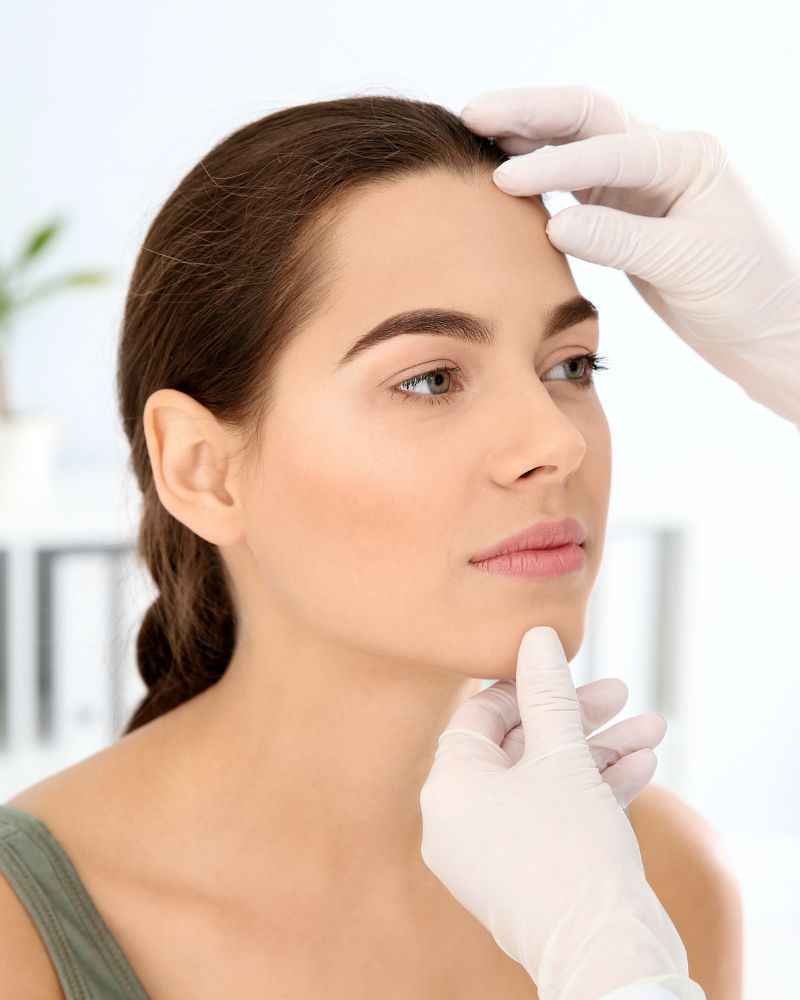
Types of Skin Cancer
Not all skin cancers look the same, and not all behave the same way. Understanding the differences can help you recognize warning signs early and seek care before a small concern becomes a larger problem.
Basal Cell Carcinoma (BCC)
Basal cell carcinoma is the most common type of skin cancer. It typically appears on sun-exposed areas such as the face, ears, neck, and scalp. BCC often looks like a pearly or waxy bump, a flat flesh-colored or brown lesion, or a sore that heals and returns. While BCC rarely spreads to other parts of the body, it can grow into surrounding tissue and cause damage if left untreated. Treatment with Mohs micrographic surgery offers cure rates of up to 99 percent for newly diagnosed basal cell carcinomas, according to the American College of Mohs Surgery.
Squamous Cell Carcinoma (SCC)
Squamous cell carcinoma is the second most common skin cancer. It often appears as a firm red bump, a scaly patch, or a sore that does not heal. SCC develops most frequently on areas with chronic sun exposure, including the face, ears, hands, and forearms. Unlike BCC, squamous cell carcinoma can be more aggressive and may spread to lymph nodes or other organs if not treated promptly. Early removal through Mohs surgery or surgical excision is the standard approach.
Melanoma
Melanoma is less common than BCC or SCC, but it is the most serious form of skin cancer. It can develop in an existing mole or appear as a new dark spot on the skin. The American Academy of Dermatology recommends using the ABCDE rule to evaluate suspicious spots:
- Asymmetry — one half does not match the other
- Border — edges are irregular, ragged, or blurred
- Color — uneven color with shades of brown, black, tan, red, or blue
- Diameter — larger than 6 millimeters (about the size of a pencil eraser)
- Evolving — the spot is changing in size, shape, or color
If you notice any of these changes, schedule an appointment with a board-certified dermatologist promptly. Melanoma detected early has a very high survival rate.
What to Expect During a Skin Cancer Screening
A skin cancer screening at Rêve Dermatology is a straightforward, noninvasive exam. Knowing what to expect can help you feel prepared and comfortable.
Before your visit, you do not need to do anything special. You may find it helpful to note any moles or spots that have changed in size, color, or shape so you can point them out to Dr. Ojong.
During the exam, Dr. Ojong will visually examine your skin from head to toe, including your scalp, between your fingers and toes, and other areas that are difficult to self-check. The exam typically takes 15 to 20 minutes. There are no needles, no lab work, and no downtime.
If a suspicious area is found, Dr. Ojong may recommend a skin biopsy. This is a quick, in-office procedure where a small tissue sample is taken and sent to a laboratory for analysis. Most patients describe the biopsy as a brief pinch with minimal discomfort. Results are typically available within one to two weeks.
After your screening, Dr. Ojong will review her findings with you and recommend a follow-up plan based on your individual risk factors. For most patients, annual screenings are sufficient.
What Is Mohs Micrographic Surgery?
Mohs micrographic surgery is the most precise and effective technique available for removing common skin cancers. Unlike standard surgical excision, which removes the visible tumor along with a margin of surrounding tissue, Mohs surgery examines 100 percent of the tissue margin during the procedure. This allows your surgeon to confirm that all cancer cells have been removed before you leave the office.
How the procedure works:
Mohs surgery removes skin cancer one thin layer at a time. After each layer is removed, your surgeon immediately examines the tissue under a microscope in our on-site laboratory. If cancer cells are still present at the edge of the tissue, another precisely targeted layer is removed from only that area. This process repeats until no cancer cells remain.
Why this approach matters:
The layer-by-layer method accomplishes two things that no other skin cancer treatment can match. First, it achieves the highest cure rate available. According to a 2024 review published in Seminars in Plastic Surgery, Mohs surgery offers the highest cure rate for many skin malignancies, including basal cell and squamous cell carcinoma. The American College of Mohs Surgery reports cure rates of up to 99 percent for newly diagnosed skin cancers.
Second, Mohs surgery preserves the maximum amount of healthy tissue. Because your surgeon only removes tissue that contains cancer, the resulting wound is as small as possible. This is especially important for skin cancers on the face, nose, ears, eyelids, lips, and hands, where preserving healthy skin directly affects your appearance and function after surgery.
Mohs surgery is performed in our office under local anesthesia. You remain awake and comfortable throughout the procedure. There is no need for general anesthesia or a hospital visit.
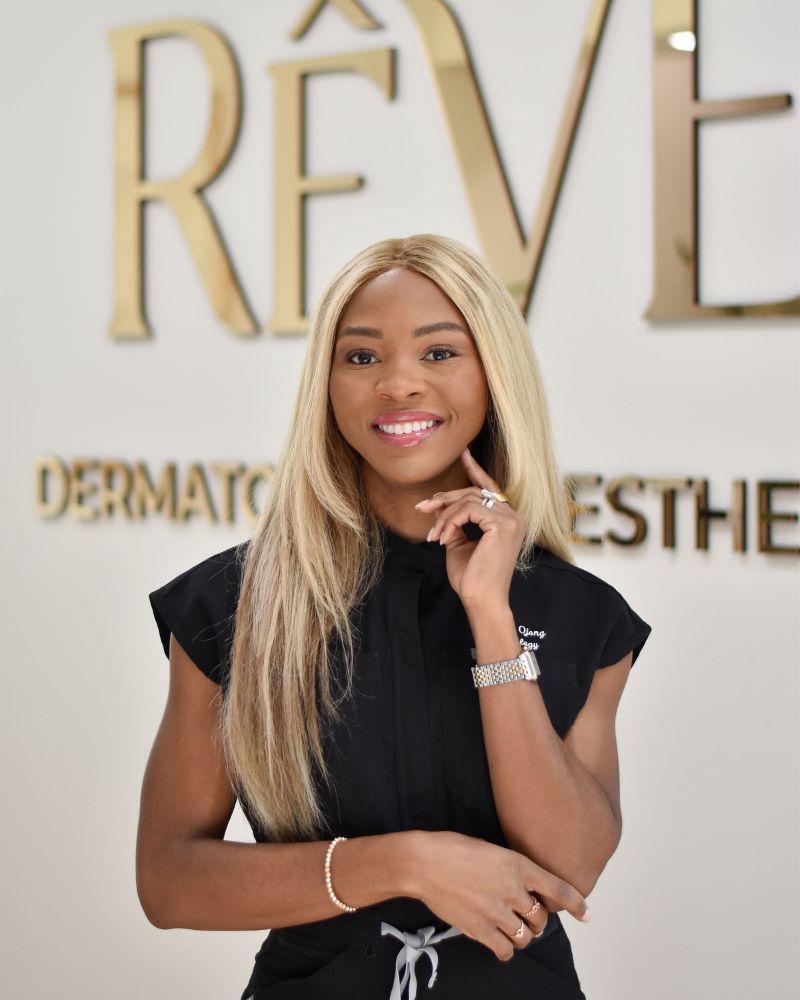
Your Mohs surgeon
Your Board-Certified Mohs Surgeon in The Woodlands
When you choose a Mohs surgeon, credentials matter. Mohs micrographic surgery requires specialized training beyond a standard dermatology residency. Not every dermatologist is qualified to perform it.
Dr. Oben Blair Ojong, DO, FAAD, is a double board-certified dermatologist and board-certified Mohs surgeon. She holds board certification in both Dermatology and Micrographic Dermatologic Surgery, a distinction shared by very few dermatologists in the greater Houston area and one that means her patients receive the highest standard of training and examination in both fields. She is a Fellow of the American Academy of Dermatology and a member of the Skin of Color Society.
What this means for your care:
- Dr. Ojong is both your surgeon and your pathologist. She removes the tissue, reads the slides, and confirms cancer clearance herself. Your care is never divided between multiple providers.
- She performs reconstruction at the time of surgery. After the cancer is removed, Dr. Ojong repairs the wound with a focus on both healing and cosmetic outcome.
- She has expertise in all skin types. As a member of the Skin of Color Society, Dr. Ojong understands how skin cancers present differently on darker skin tones and how to minimize visible scarring across diverse skin types.
Choosing a board-certified Mohs surgeon means choosing the highest level of precision, safety, and expertise available for your skin cancer treatment.
When Is Mohs Surgery Recommended?
Mohs surgery is not used for every skin cancer. Your dermatologist may recommend it when the cancer requires the highest level of precision in removal and tissue preservation. The American College of Mohs Surgery recognizes specific situations where Mohs is the preferred treatment approach.
Mohs surgery is typically recommended when skin cancer:
- Is located on the face, nose, ears, eyelids, lips, scalp, hands, feet, or genitals — areas where preserving healthy tissue and minimizing scarring is a priority
- Is large or has poorly defined borders
- Is an aggressive or high-risk subtype of basal cell or squamous cell carcinoma
- Has come back after previous treatment (recurrent skin cancer)
- Is growing in an area of prior radiation or scar tissue
- Is located near nerves, blood vessels, or bone
Mohs surgery is also recommended for patients who want the lowest possible recurrence rate. Because the procedure examines 100 percent of the surgical margin, it leaves less room for cancer cells to remain undetected compared to standard excision.
Dr. Ojong evaluates each patient individually to determine whether Mohs surgery is the most appropriate option. In some cases, a standard surgical excision may be sufficient. During your consultation, she will review your biopsy results, examine the area, and explain which approach gives you the best outcome with the least impact on your appearance.
Not sure whether your skin cancer requires Mohs surgery? Dr. Ojong can review your biopsy report and advise you during a consultation.
What to Expect on the Day of Mohs Surgery
Understanding the process ahead of time can help you feel prepared and at ease. Mohs surgery is performed in our office in The Woodlands — there is no hospital visit or general anesthesia required.
Arrival and preparation. Plan to be at our office for several hours. The total time depends on the size and complexity of your skin cancer, but most patients can expect to be with us for two to four hours. Wear comfortable clothing and bring something to read or watch during waiting periods between stages.
Local anesthesia. Dr. Ojong will numb the treatment area with a local anesthetic. You will be fully awake and comfortable throughout the procedure. Most patients describe the numbing injection as a brief sting that fades quickly.
Layer-by-layer removal. Dr. Ojong removes a thin layer of tissue and examines it under a microscope in our on-site lab. If cancer cells are present at the margin, she removes another targeted layer from only that area. This cycle continues until the tissue is completely clear. Each round typically takes 30 to 45 minutes, including lab processing time.
Same-day wound repair and reconstruction. Once Dr. Ojong confirms that all cancer has been removed, she repairs the surgical site during the same visit. Depending on the size and location of the wound, repair options may include direct closure with sutures, a local skin flap, or a skin graft. Dr. Ojong plans every repair with both healing and cosmetic outcome in mind, which is especially important for skin cancers on the face and other visible areas.
Before you leave, Dr. Ojong will review wound care instructions with you and schedule a follow-up appointment to check your healing.
Recovery After Mohs Surgery
Most patients are surprised by how manageable recovery is after Mohs surgery. While every case is different, the majority of patients return to normal daily activities within a few days.
The first 24 to 48 hours. Some swelling, bruising, and mild soreness around the surgical site are completely normal. Dr. Ojong will prescribe or recommend appropriate pain management, though most patients find that over-the-counter options are sufficient. Keeping the area clean, dry, and bandaged per your aftercare instructions is the most important thing you can do during this time.
The first one to two weeks. You will have a follow-up appointment with Dr. Ojong to check your healing and, if needed, remove sutures. Most patients notice steady improvement during this period. Bruising and swelling typically fade within 7 to 10 days. Avoid strenuous exercise, heavy lifting, and anything that increases blood flow to the area until Dr. Ojong clears you.
Long-term healing and scarring. The surgical site will continue to heal and improve in appearance over several months. Dr. Ojong plans every repair to minimize visible scarring, and she will advise you on scar care techniques that can further improve your result. Most patients find that the final scar is much smaller and less noticeable than they expected.
When to contact our office. Call us at (346) 351-6622 if you experience excessive bleeding that does not stop with gentle pressure, signs of infection such as increasing redness or warmth, fever, or unexpected changes at the surgical site. These situations are uncommon, but we want you to feel confident reaching out if anything concerns you.
Additional Skin Cancer and Surgical Services
Mohs surgery is one part of the comprehensive skin cancer care available at Rêve Dermatology & Aesthetics. Dr. Ojong also provides the following diagnostic and surgical services in The Woodlands.
- Skin biopsies — same-day tissue sampling to evaluate suspicious spots and confirm or rule out a skin cancer diagnosis
- Surgical excision — removal of confirmed skin cancers, cysts, lipomas, and other growths that do not require Mohs surgery
- Mole evaluation and removal — assessment of atypical moles and elective removal for medical or cosmetic reasons
- Skin tag removal — quick in-office removal of benign skin growths, offered as an elective cosmetic service
- Post-surgical follow-up and monitoring — ongoing skin surveillance for patients with a history of skin cancer, including regular full-body exams and early intervention if recurrence is detected
If your primary care physician, another dermatologist, or an oncologist has referred you for skin cancer treatment, Dr. Ojong welcomes outside referrals and will coordinate with your care team.
Frequently Asked Questions About Skin Cancer and Mohs Surgery
What are the most common types of skin cancer?
The three most common types are basal cell carcinoma (BCC), squamous cell carcinoma (SCC), and melanoma. BCC is the most frequently diagnosed and tends to grow slowly. SCC can be more aggressive and may spread if not treated early. Melanoma is less common but is the most serious form and requires prompt evaluation.
How is skin cancer diagnosed?
Diagnosis begins with a visual skin examination by a board-certified dermatologist. If Dr. Ojong identifies a suspicious area during your screening, she may perform a skin biopsy — a quick, in-office procedure where a small tissue sample is sent to a laboratory for analysis. Results are typically available within one to two weeks.
What is Mohs micrographic surgery?
Mohs surgery is a specialized technique that removes skin cancer one layer at a time. After each layer is removed, your surgeon examines the tissue under a microscope to check for remaining cancer cells. This process continues until the margins are completely clear. It offers the highest cure rate of any skin cancer treatment and preserves the maximum amount of healthy tissue.
Why is Mohs surgery recommended for certain skin cancers?
Mohs surgery is the preferred treatment when skin cancer is located on the face, nose, ears, eyelids, hands, or other areas where preserving tissue and appearance is important. It is also recommended for large, aggressive, or recurrent skin cancers. The precision of the technique results in the smallest possible wound and the lowest chance of recurrence.
What can I expect during and after Mohs surgery?
The procedure is performed in our Woodlands office under local anesthesia. Plan to be with us for two to four hours. After surgery, Dr. Ojong repairs the wound during the same visit. Most patients experience mild soreness and swelling that resolves within one to two weeks. A follow-up appointment is scheduled to check your healing.
How can I reduce my risk of skin cancer?
Apply a broad-spectrum sunscreen with SPF 30 or higher every day, even on cloudy days. Wear protective clothing and a wide-brimmed hat when outdoors. Avoid tanning beds entirely. Stay out of direct sun during peak hours, typically between 10 a.m. and 4 p.m. In addition to these habits, schedule annual skin cancer screenings with a board-certified dermatologist for professional monitoring.
How much does Mohs surgery cost, and is it covered by insurance?
Dr. Ojong accepts insurance for Mohs surgery, including Medicare and supplemental plans, Aetna, Cigna, Blue Cross Blue Shield, Ambetter, Amerigroup, Humana, United Healthcare, Tricare, VA (Veterans Health Administration), WellMed, Kelsey-Seybold Network, Mutual of Omaha, Meritan Health, and others. Out-of-network reimbursement may be available depending on your plan. Please note that we do not accept Medicaid. For specific cost and coverage questions, please contact our office at (346) 351-6622. Our team can help you verify your benefits before your appointment.
Can any dermatologist perform Mohs surgery?
No. Mohs micrographic surgery requires specialized training beyond a general dermatology residency. A board-certified Mohs surgeon has completed additional rigorous training and examination specifically in this technique, including how to act as both the surgeon and the pathologist during the procedure. Dr. Ojong is board-certified in Micrographic Dermatologic Surgery, which means she has met the highest standard of qualification recognized for Mohs surgeons in the United States. When choosing a surgeon for skin cancer removal, confirming board certification in Mohs surgery is one of the most important steps you can take.
Schedule Your Skin Cancer Screening or Mohs Surgery Consultation
Whether you need a routine skin exam, a second opinion on a biopsy result, or a consultation with a board-certified Mohs surgeon, Rêve Dermatology & Aesthetics is here to help. Dr. Oben Blair Ojong is accepting new patients in The Woodlands, TX.
Early detection is the best protection. Do not wait to have a suspicious spot evaluated.
Call: (346) 351-6622
Visit: 9323 Pinecroft Dr, Suite 202, The Woodlands, TX 77380
Get in touch!
Contact Us
Location
9323 Pinecroft Dr, Ste 202
The Woodlands, TX 77380
© Copyright 2026 Rêve Dermatology and Aesthetics
| Accessibility | Privacy |